
Arrest Records in Schuyler County
The Schuyler County Sheriff, Rushville Police Department, Illinois State Police, conservation police, and federal agencies can create arrest records when their jurisdiction applies. In the small villages, the Sheriff is often the practical first call, but the actual investigating agency remains the custodian of its report. An arrest based on probable cause or a warrant is an allegation and a custody event. It is not a finding of guilt.
One event may create four trails. The officer writes an incident or arrest narrative. If the person enters the county jail, Sheriff staff create the booking and custody file. Fingerprints form a transaction sent to the Illinois State Police Bureau of Identification. If prosecutors file charges, the Circuit Clerk opens a court case. Charge wording can differ across these records because an officer's initial basis for arrest is not always the count filed in court.
Schuyler Sheriff App Booking Route
The Sheriff advertises its mobile app as the primary digital channel for inmate information and jail rosters. The office announced that department updates, alerts, and resources will move fully to the app when its website is scheduled to cease operation on July 22, 2026. This creates an app-first system rather than a stable browser booking page. Readers should use the official app or call the active jail at 217-322-4366.
The official Android listing documents the app.
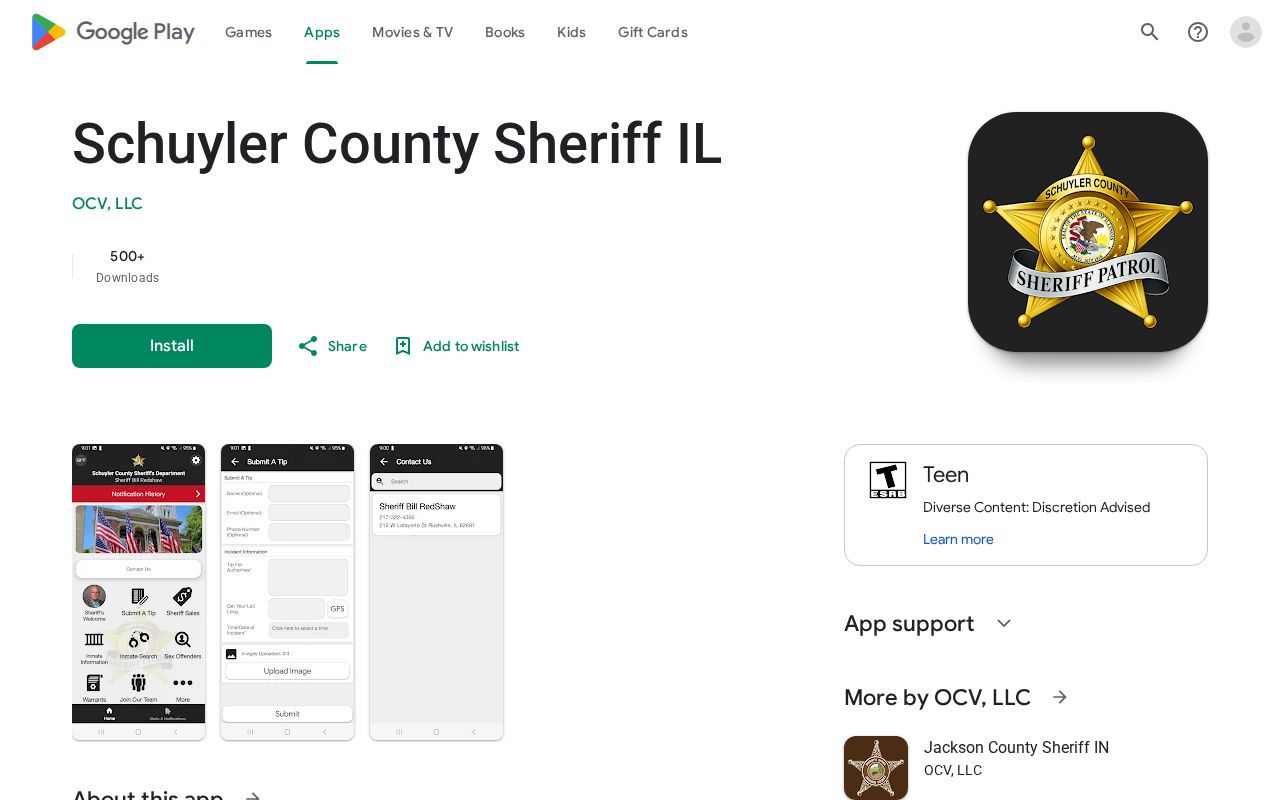
The listing identifies “Schuyler County Sheriff IL” and offers agency contacts and safety resources alongside the jail information described by the Sheriff.
A blank web search is therefore a poor test. It may show that the browser page is gone, not that no booking occurred. A person can also be cited and released, transferred, or booked elsewhere. Ask the jail whether the subject is held, released, transferred, or was never admitted there.
Schuyler County Arrest Lookups
No single public screen provides every Schuyler County arrest record. Current custody belongs with the Sheriff. The narrative belongs with the agency that made or investigated the arrest. Filed charges belong with the court. Statewide public conviction information comes from ISP under UCIA, while a person reviewing their own full state history uses fingerprint-based Access and Review.
- Check the official Sheriff app's inmate or jail-roster feature, then call 217-322-4366 to confirm current custody and release or transfer status.
- Ask which agency made the arrest. Request its incident or arrest report with the date, time, location, and report number if known.
- Search Schuyler Judici for a filed case. Allow time for prosecutor filing and clerk data entry after a recent event.
- Use ISP UCIA for public statewide conviction information, not as a live recent-arrest feed. Use Access and Review for one's own complete Illinois history.
- Submit the county FOIA form to the office that created the report when app, phone, and court results do not answer the request.
The Sheriff and jail are at 216 West Lafayette Street in Rushville. The county FOIA directory also prints 217-322-4367, but the Sheriff and jail inspection use 217-322-4366 as the main number.
Four Trails From One Schuyler Arrest
The record trail moves in a sequence, but each custodian controls its own part. An officer documents the event and legal basis. Jail staff confirm authority, inventory property, capture identity, fingerprints, and a booking image, and screen for medical, mental-health, and security needs. The fingerprint transaction goes to ISP. The prosecutor then decides which charge, if any, should be filed.
Record flow: Officer Report › Sheriff Booking › ISP Fingerprint Cycle › Prosecutor Filing › Circuit Court Outcome
A delay or gap at one step does not erase the others. A cited person may have no jail booking. A booking may precede the court case by enough time that Judici is still blank. An arrest charge may be changed before filing. The court may dismiss a count or enter an acquittal. When facts conflict, compare dates, report and booking numbers, and the final filed order rather than forcing one record to answer every question.
Arrest Records: What They Contain
A Schuyler County arrest report may list the event number, date, time, location, officer, agency, warrant or probable-cause basis, alleged statute, subject identifiers, evidence, and a narrative. A jail file adds admission, identity capture, intake property, screening, housing, custody, and release or transfer information. Public copies can omit victim, juvenile, medical, private, or active-investigation details.
| Report or Booking Number | The agency key used to request and match the event. |
|---|---|
| Date, Time, and Place | When and where the arrest or jail intake occurred. |
| Arresting Agency | The office that usually holds the arrest narrative. |
| Initial Charges | The officer's alleged offenses, which may change before court filing. |
| Legal Authority | A warrant or the stated probable-cause basis for custody. |
| Custody Status | Held, released, or transferred status when the jail record exposes it. |
| Booking Image | An intake identity image; no official Schuyler public mugshot gallery was found. |
| Release Information | The recorded release or transfer event, subject to current court orders. |
The app's expected profile fields may include name, booking or record number, booking time, agency, charge descriptions, case reference, and release data. The public web description did not confirm every field, so a reader should not assume that the app displays a full report.
Request a Schuyler Arrest Narrative
The county does not advertise a large stand-alone Sheriff records division. Direct Sheriff-created report requests to 216 West Lafayette Street, Rushville, Illinois 62681. Name the record, date, place, involved agency, and report or booking number. State whether inspection or copies are wanted. For a Rushville Police event, use the city police or city hall custodian. ISP reports follow ISP channels, including its separate crash-report process when applicable.
Schuyler County Sheriff and Jail
216 W. Lafayette St.
Rushville, IL 62681
217-322-4366
Call first for custody and report routing.
Illinois FOIA generally gives a public body five business days to respond to a noncommercial request, with a written five-business-day extension allowed for statutory reasons. The office may disclose, redact and partly disclose, deny under a cited exemption, report that no responsive record exists, or redirect the request to the real custodian. No official special Sheriff report fee was located, so ask for a cost estimate before approving broad copying or media work.
The Illinois FOIA response rule governs agency requests, while court files are obtained from the Circuit Clerk under judicial access rules.
The statute source illustrates the response process used for Schuyler County agency arrest records.
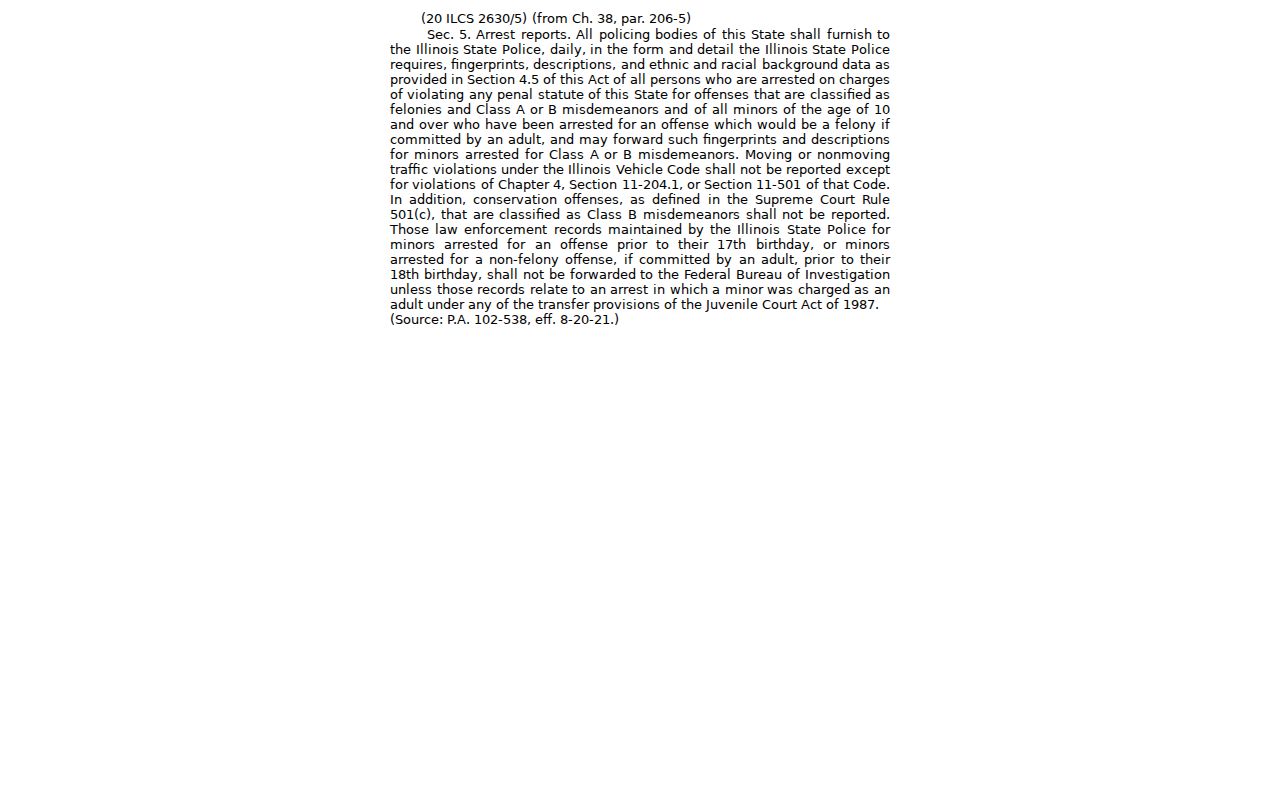
Reporting duties connect the local fingerprint arrest cycle to the state repository, but the local agency still holds its own narrative.
Recent Schuyler County Bookings
The current route for recent booking information is the Sheriff app or the jail phone. The active jail sits behind the courthouse on West Lafayette. It is not the restored old jail at 200 South Congress, which is now a museum and genealogy center. That local distinction prevents a common wrong turn when a search result mentions “Schuyler Jail.”
An official 2024 IDOC inspection describes the active jail as a 21-bed facility built in 1987. Inspectors counted 11 people on the inspection date and noted that it housed people from other jurisdictions. Those numbers are a dated snapshot, not a live roster. They should never be used to claim who is held today or to infer a crime trend.
A roster is also not a lifelong arrest log. Entries may roll off after release, and a person may be transferred or never booked at this jail. The absence of a current app result proves neither that an arrest did not happen nor that the person has no older arrest. For older material, request the Sheriff's booking record and then check the arresting agency report.
No Judici Case After an Arrest
Judici begins at the filed court case, not at the street arrest. A blank result soon after an incident can mean that the prosecutor has not filed a charge, the clerk has not entered it, the name differs, or the person was released without a county-jail stay. It can also mean no prosecution was filed. The screen alone cannot choose among those facts.
First confirm the event with the arresting agency and booking office. Ask for the report and case reference. Then search Judici again with spelling variants or a case number. Once a prosecution appears, the Schuyler County court case file is the source for filed counts and outcomes. This is one of the few places where the arrest and court trails should be linked, but they should not be merged.
Note: No immediate court result is not proof that no arrest occurred, and a booking entry is not proof that charges were filed.
Schuyler Arrests and Pretrial Release
At jail intake, staff confirm the authority for custody, record charges and identity, and conduct required screening. The court then holds the initial pretrial proceeding. Illinois changed its pretrial system under the Pretrial Fairness Act. Older booking records may speak of bond or cash amounts, but current cases turn on the judge's release or detention order and its conditions.
“Bond” can refer to release conditions in older material. “Recognizance” means release based on a promise and conditions rather than a money deposit. Neither label establishes guilt. For a current Schuyler County arrest, read the latest court order. The jail can report custody status, but it does not interpret the legal effect of a judicial ruling.
The statute governing Illinois criminal-history reporting is available from the Illinois General Assembly.
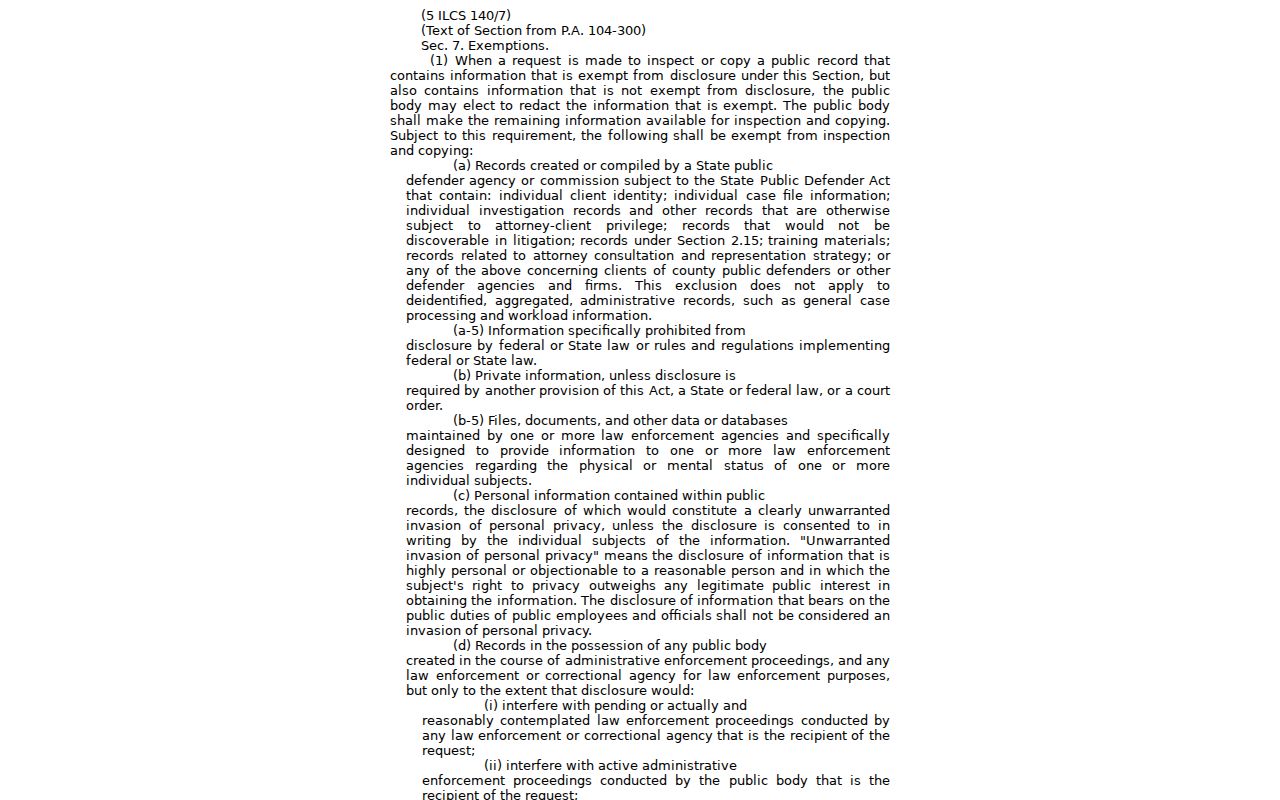
It helps explain why fingerprints and later dispositions must be paired in the state record cycle.
Arrest Records vs Conviction Records
An arrest entry documents an allegation and custody event. A conviction follows a guilty plea or verdict and judgment. The arresting agency and Sheriff hold local arrest and booking material. The Circuit Clerk preserves the court outcome, and ISP disseminates public conviction information under the Uniform Conviction Information Act. These sources may all refer to the same event, yet none is a substitute for the others.
| Point | Arrest Record | Conviction Record |
|---|---|---|
| Creator | Arresting agency and jail | Court, then state repository reporting |
| Meaning | An arrest or booking occurred | A court entered a judgment of guilt |
| Location | Agency report, Sheriff booking file | Circuit Clerk, Judici, ISP UCIA |
| Possible ending | Release, transfer, no filing, or later case | Sentence, appeal, sealing, or other later order |
Dismissal or acquittal changes the court outcome but does not automatically remove every agency record. Eligible people may seek expungement or sealing under 20 ILCS 2630/5.2. A court decides eligibility, and agencies need time to process an entered order.
The Illinois expungement and sealing law sets the relief process.
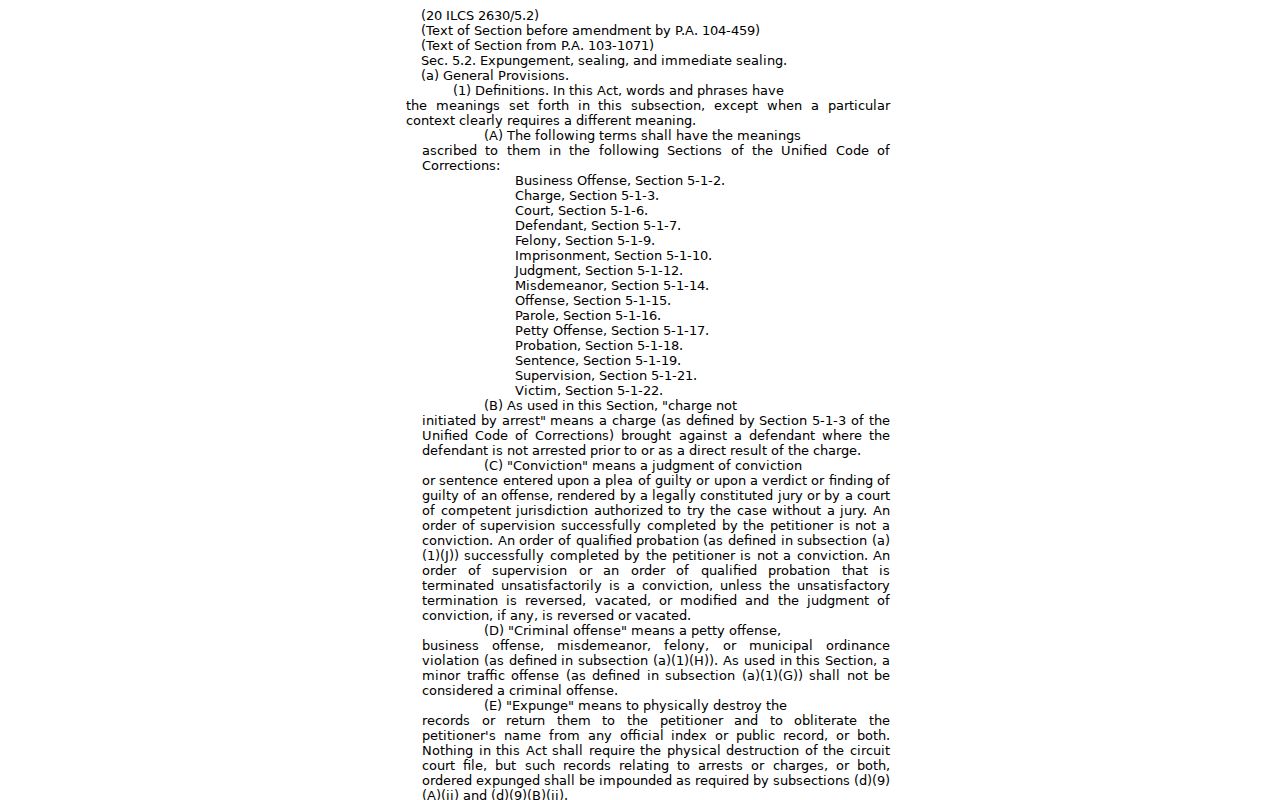
It confirms why a non-conviction outcome and removal from public view are separate steps.
Note: An arrest is not proof of guilt; some arrests lead to no filed charge, dismissal, or acquittal.